i.
Create a project, upload your maps.
Drag in orthomosaics, GeoJSONs, shapefiles — or anything else you've got. We accept most formats teams actually use.
Drone surveys, orthomosaics, and site maps hold the answers your team needs — but they're too big and too dense to read by hand. TerraQuery turns them into something you can simply ask.
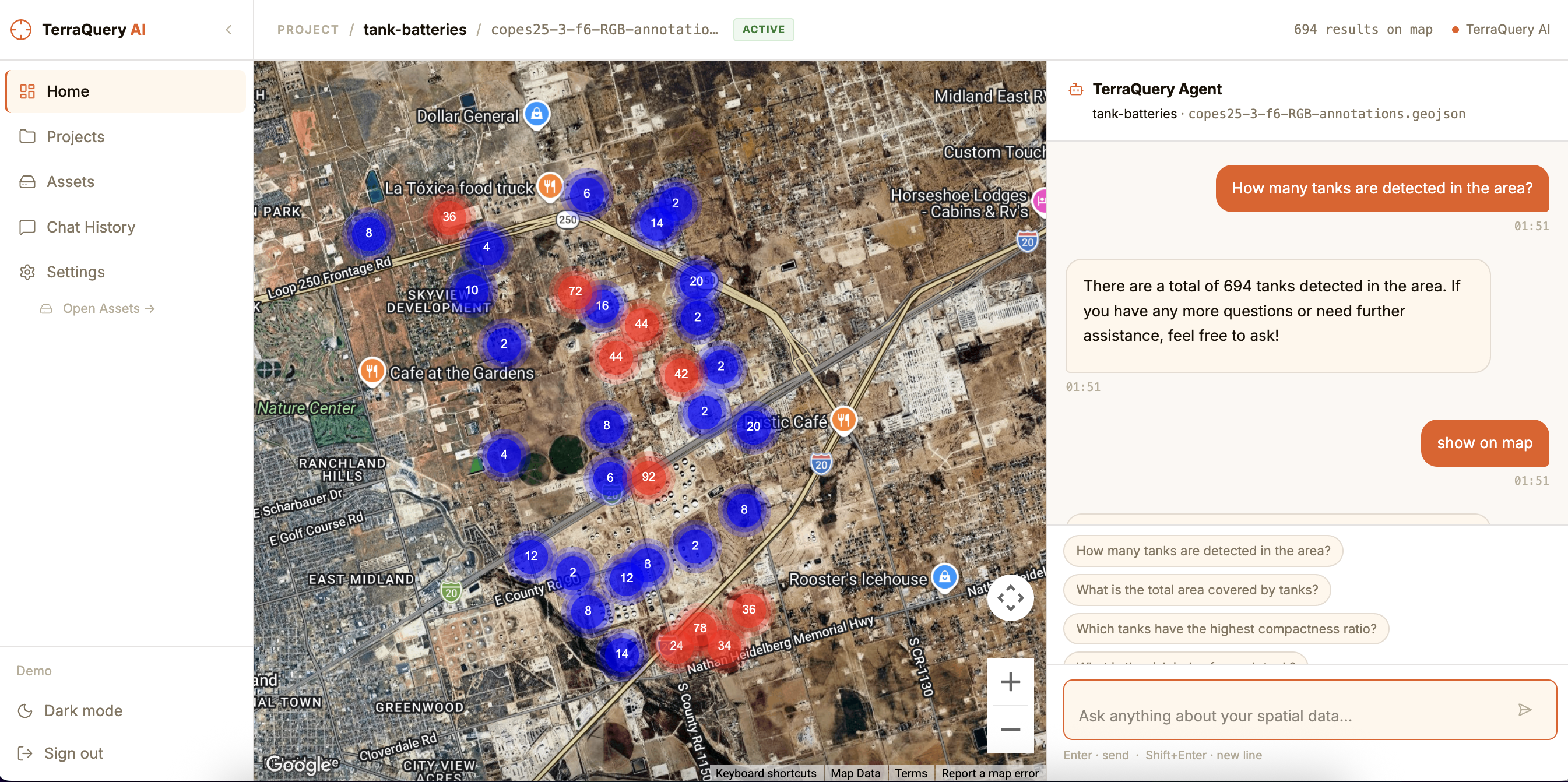
Every site survey, every drone flight, every quarterly scan produces another twenty gigabytes of imagery and shapefiles. Most of it sits in a folder nobody opens.
It's not that the answers aren't there. It's that finding them takes a trained specialist, the right software, and a free afternoon.
No GIS training required. Upload what you've got, wait a few minutes, and start asking questions.
Drag in orthomosaics, GeoJSONs, shapefiles — or anything else you've got. We accept most formats teams actually use.
TerraQuery reads, tiles, and understands your data. A 4 GB orthomosaic becomes searchable in minutes — you don't have to know how.
"How many trees on this plot?" "Where is the surface cracked?" "Which panels are misaligned?" Get the answer, on the map, with the count.
Wherever drones, surveys and inspections produce more data than your team can review — TerraQuery sits on top and answers questions about it.
Inspect bridges, roads and rail across miles of imagery without sending a person to look.
"Where are the cracks on span 12?"Find dirty, broken, or misaligned panels across whole solar farms in one pass.
"Which strings are underperforming?"Track crop stress, count trees, measure plant gaps — per plot, per season, per scan.
"Where is yield trending down?"Monitor pipelines, well pads, and tank farms — ask about leaks, encroachment, or change.
"What's new since last quarter's flyover?"Compare today's site against the plan. Catch deviations and progress in one prompt.
"Is the foundation pour on schedule?"Ask a question and TerraQuery often replies with more than text — a marked-up map, a one-click export, a draft report ready to send to the field team.
TerraQuery is in private beta. Tell us a little about your work and we'll set you up with a project on a slice of your own data — usually within two business days.
A small form, and then a real demo on a map of yours.
Prefer email? Write to hello@terraquery.ai. Looking for pricing? See plans.
Create your account and tell us about your data on the next page. It takes about two minutes.
Request access →No credit card. We reply within two business days.
A few details and we'll be in touch within two business days.
We'll reach out from access@terraquery.ai with next steps.